10/21/15

Back to The 1985.

Today is October 21, 2015 - the famous "Back to the Future Day". In "Back to the Future Part II," Marty McFly travels to October 21, 2015, to save his children, yet to be born in "Back to the Future's" 1985.


We will go to oposit time direction, to the 1985 to see 5 most popular games from that year!

1. Super Mario Bros. (NES)


Plumber brothers Mario and Luigi are transported to the Mushroom Kingdom, where they must stop the evil Koopa King, Bowser, and his reign of terror.


2. Bruce Lee (ZX Spectrum 48K)


Bruce Lee is a platform/beat 'em up hybrid, in which the player controls Bruce Lee. The plot involves the eponymous martial artist advancing from chamber to chamber in a wizard's tower, seeking to claim infinite wealth and the secret of immortality. There are twenty chambers, each represented by a single screen with platforms and ladders. To progress, the player must collect a number of lanterns suspended from various points in the chamber.


3. The Goonies (Commodore 64)


A good conversion of the movie The Goonies in a video game. Multicoloured 2D graphics, whereby each level covers one screen. 8 rather tricky levels need to be solved and can demand a lot from you.


The Goonies are a group of kids or youths. Everything starts with an unscrupulous property shark who wants to purchase the kids' housing complex and the parents lack the money that is needed to prevent the pending sequestration.
In the house of their leader Mikey the group makes an unusual discovery. They find a treasure map which is supposed to lead to the hideout of "One-eyed Willie", a pirate.
Mikey can convince his friends to go for a treasure hunt. This starts in an abandoned restaurant. The evil Fratellis have settled in there. So after all Goonies, except for Chunk who is supposed to call the police, have entered a system of catacombs through a manhole in the restaurant, the adventure really begins. So the kids do not only have to beware of mean traps and bats, but also of Mama Fratelli.
The game starts in the restaurant with the search for the manhole into the catacombs and contains 8 rather tricky levels full of riddles and adversities. The aim of the game is to bring safely both Goonies to the exit in Level 1-7 and in the eighth level to get to the treasure with both Goonies. Help the Goonies during their adventure...

4. Star Wars: The Empire Strikes Back (Amiga)


Star Wars: The Empire Strikes Back is the sequel to the vector graphics Star Wars arcade game. It was released by Atari Games in 1985 as a conversion kit for the original game. As in Star Wars, the player takes the role of Luke Skywalker in a set of familiar battle sequences in a first-person perspective. Specifically, the arcade features the Battle of Hoth and the subsequent escape of the Millennium Falcon through an asteroid field. The game was also released for various home computers in the late 80's by Software company Domark Ltd. Ports of the game included the Amstrad CPC, ZX Spectrum, Atari St & Commodore 64 and Amiga.


5. Where in the World Is Carmen Sandiego? (IBM PC - DOS)


The goal of the game is to track Carmen's villains around the world, arrest them and ultimately arrest Carmen herself. The player begins the game by first going to the country where the crime took place and then obtaining hints from various sources on where the thief went next, leading to a chase around the world to find the thief before time runs out.


Each case begins with the user being alerted that a spectacular theft has been committed. Starting by first traveling to the scene of the crime, the player is given several opportunities to collect clues about the suspect's next location, which come in the form of pun-filled word play about the target place. There are thirty countries that can be visited in the game and each is identified by the name of a prominent city, though this city is not always consistent with the image of the country shown in the game. For example, Lima is given for Peru, but the game instead shows an image of Machu Picchu.

If the player travels to an incorrect location, they receive nonsensical clues and will have to backtrack to the previous location to try again. If the player travels to the correct location, a simple animation of an obvious but otherwise harmless V.I.L.E. henchman lurking across the screen is played. The gameplay continues to repeat in this manner as the player travels from location to location several times before catching up to the criminal.


10/16/15

Sokoban (1984.)

Sokoban is a old DOS sokoban puzzle game developed by Spectrum HoloByte in 1984 from an original idea by Khaled Bentebal. Soko-Ban can be enjoyed by up to 1 player from a top down perspective.


Sokoban is a very simple game. There are a lot of crates that need to be pushed to the right spaces. To do this, you are in control of a little man, who can walk and push. The first 5-6 levels are fairly easy, and won't take a lot of time. Then it slowly becomes harder and harder. When you have completed the first 15-20 levels, you will have to think many steps forward to advance further. There are 50 levels in the game, so you can play it for many hours.


If you would like to challenge your friends, you can play multiplayer. Then you play in turn, and will get points after the number of moves used and the time passed. And if this is not enough, there is an integrated level editor, so you can make your own levels. When I was a kid, the guys and me used a lot of time making levels to challenge each other.


The sound in Sokoban is nothing to brag about. The only sound there is in the game is the steps of the man when he moves, and a little melody when a level is complete. This is played via the pc-speaker. The graphics are nice, if you think of how old the game is. But these things are really not important in this game, as it's the puzzle that you should focus on.

Graphics: CGA, Tandy
Sound: PC speaker
Size:  390KB


Defender of the Crown (1986.)

Defender of the Crown is a strategy computer game designed by Kellyn Beck. It was Cinemaware's first game, and was originally released for the Commodore Amiga in 1986, setting a new standard for graphic quality in home computer games.


In 1987 it was ported to DOS, the Nintendo Entertainment System (NES), Atari ST, ZX Spectrum, Amstrad CPC, Commodore 64, Macintosh and finally, the Apple IIGS in 1988. It was later ported to the CD-i.

(DOS Version)

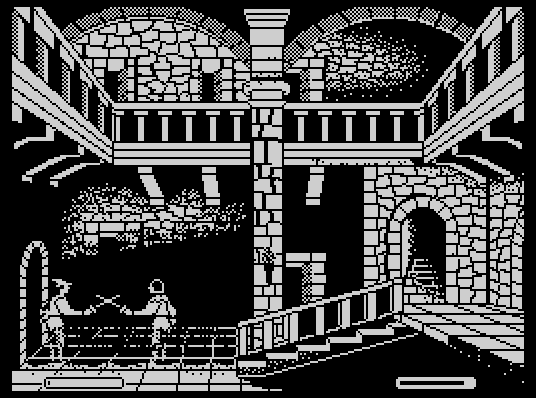
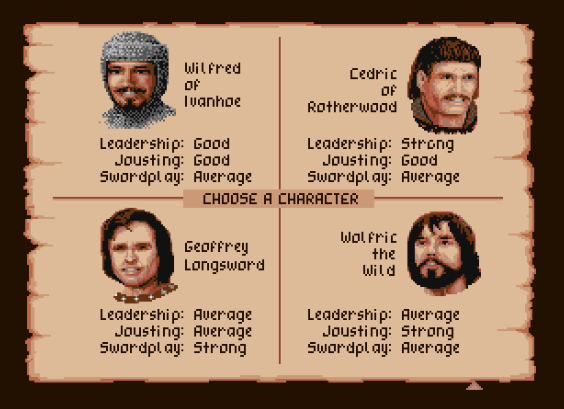
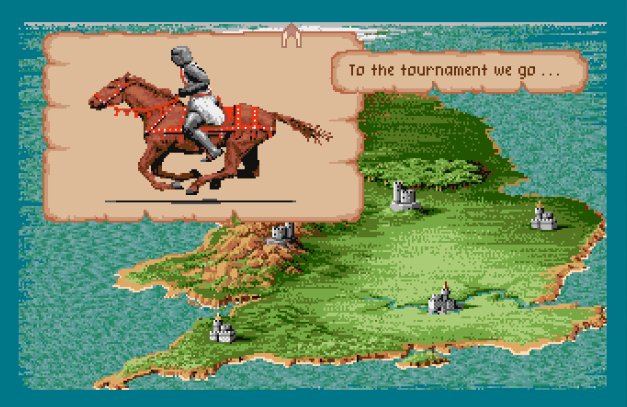
The game is set in England in 1149 during the Middle Ages where, following the death of the king, different factions are fighting for territorial control. The player assumes the role of a Saxon (Wilfred of Ivanhoe, Cedric of Rotherwood, Geoffrey Longsword or Wolfric the Wild) and tries to fight off the Norman hordes and wrestle for control of England. Eventually, the player must fight for control of all territories, and potentially those controlled by other Saxons, if they have become antagonistic. The player must amass armies and fight for control of opponents' castles. The player may engage enemy armies in battle, loot or lay siege to opposing castles. Territories can also be won in the periodic jousting contests. From time to time the player may attempt to rescue a damsel in distress and can appeal for help from the legendary bandit Robin Hood.


 (ZX Spectrum 48K version)

The game's strategy boils down to a war of attrition as the player tries to amass larger armies than his opponents and manages to attack their territories at the right time.

Due to financial strains, Cinemaware decided to release the initial version without all the features originally planned for because of their need for revenue. Some features were partially implemented, but were removed so the game could be shipped. Some additional features completed but never seen in the shipped game include flaming fireballs (launched via the catapult), more locations (more varied castles to attack) and more in-depth strategy. Some of these features were implemented in the ports of the game.


(Amiga version)


Jim Sachs, the primary artist for the game, showcased some of these features on the Amiga during interviews after the release of the game.


Platforms:
DOS, NES, Apple IIGS, Atari ST, Apple Macintosh, ZX Spectrum, Amstrad CPC, Commodore 64, Commodore Amiga, Commodore CDTV, CD-i, Windows, Game Boy Advance, iOS


10/15/15

Windows 3.11 for Workgroups

Windows 3.1x (codenamed Janus) is a series of 16-bit operating systems produced by Microsoft for use on personal computers. The series began with Windows 3.1, which was first sold during April 1992 as a successor to Windows 3.0. Subsequent versions were released between 1992 and 1994 until the series was superseded by Windows 95. During its lifespan, Windows 3.1 introduced several enhancements to the still MS-DOS-based platform, including improved system stability, expanded support for multimedia, TrueType fonts, and workgroup networking.


Windows 3.11 was released on November 8, 1993. It did not add any feature improvements over Windows 3.1; it only corrected problems.


Windows for Workgroups is an extension that allowed users to share their resources and to request those of others without a centralized authentication server. It used SMB protocol over NetBIOS. 

Windows for Workgroups 3.11 (originally codenamed Snowball) was released on August 11, 1993,[15] and shipped in November 1993.[16] It supported 32-bit file access, full 32-bit network redirectors, and VCACHE.386 file cache, shared between them. WFW 3.11 dropped standard mode support and requires a 386 machine to run.


A Winsock package was required to support TCP/IP networking in Windows 3.x. Usually third-party packages were used, but in August 1994, Microsoft released an add-on package (codenamed Wolverine) that provided TCP/IP support in Windows for Workgroups 3.11. Wolverine was a 32-bit stack (accessible from 16-bit Windows applications via WinSock Thunk), which gave it superior performance to most of the third-party TCP/IP Windows stacks available. However, it was only compatible with Windows for Workgroups 3.11, and lacked support for dial-up. Wolverine stack was an early version of the TCP/IP stack that would later ship with Windows 95, and provided an early testbed for the 16-to-32-bit compatibility layer that was crucial to Windows 95's success.

Following the release of MS-DOS 6.22 in 1994, WFW 3.11 largely replaced Windows 3.1 for OEM installations on new PCs due to its improved capabilities and greater stability.


Windows 3.1x introduced new possibilities for applications, especially multimedia applications. During this era, Microsoft developed a new range of software that was implemented on this operating environment, called Microsoft Home, Microsoft Bob being one of the programs.

As the first versions of Windows to enjoy major commercial success and software support, Windows 3.1 and WFW 3.11 quickly replaced DOS as the platform for application software on PC compatibles. Multimedia software (especially games) proliferated, although many games continued to run on DOS until Windows 95.

Requirements:

 - MS-DOS 3.3 or later (6.2 or later recommended).
 - PC with 386SX or higher processor.
 - 3 MB RAM; 4 MB recommended (with no network installed, requires only
   2 MB).
 - One 5.25" or 3.5" high-density, or 3.5" low-density disk drive.
 - Hard disk drive with 10.5 MB available space (15.5 MB recommended).
 - VGA, Super VGA, 8514/A, or video graphics adapter and monitor
   compatible with Windows 3.1 (color VGA or better resolution monitor
   recommended).
 - For fax capability: Class 1, Class 2, or Communications Application
   Specification (CAS) modem required (only Class 1 modems will support
   binary file transfer).
 - Microsoft Windows-compatible network adapter card and cabling. NOTE: No
   network hardware (network adapter card and cabling) is required if you
   want to run WFW with networking turned off.

Options:

 - Microsoft Mouse or compatible pointing device (mouse recommended).
 - Hayes or compatible modem.
 - Audio board.
 - CD-ROM drive.


Leisure Suit Larry in the Land of the Lounge Lizards (1987)

Leisure Suit Larry in the Land of the Lounge Lizards is a graphic adventure game originally released  in 1987 as the first part of the Leisure Suit Larry series. Originally developed for the PC DOS and the Apple II, it was later ported to other platforms such as the Amiga, Atari ST, Apple IIGS, Apple  Macintosh, and the Tandy Color Computer 3. It utilizes the Adventure Game Interpreter (AGI) engine made famous by King's Quest: Quest for the Crown.


The game's story follows a middle-aged male virgin named Larry Laffer as he desperately tries to "get lucky" in the fictional American city of Lost Wages. Land of the Lounge Lizards establishes several elements which recur in the later Larry games, including Larry's campy attire, perpetual bad luck with women, and penchant for double-entendres. The story and basic structure of the game are lifted from Softporn Adventure, a 1981 Apple II text adventure.


Larry Laffer is a 38-year-old (40-year-old in the 1991 remake) "loser" who lives in his mother's basement and has not yet lost his virginity. Having grown weary of his lonely existence, he decides to visit the resort city of Lost Wages (a parody of "Las Vegas") hoping to experience what he has not lived before, and to finally find the woman of his dreams. Larry starts with nothing but an out-of-style 1970s disco-era leisure suit and $94 in his pocket. His quest involves four possible women: a nameless, seedy-looking sex worker; Fawn, a club-goer of low moral fiber; Faith, a receptionist who (true to her name) is faithful to her boyfriend; and Eve, a bathing beauty and Larry's ultimate goal.

DOWNLOAD:

GAME SOLUTION:


Single line programming

Can we make interesting graphics with only single program line? Yes, we can!

ZX Spectrum 48K - BASIC:
10 PRINT CHR$(132.2+RND*1);:GO TO 10


Iskra Delta Partner - MBasic:
10 PRINT CHR$(94.2+RND(1));:GOTO 10


Commodore 64 - BASIC:
10 PRINT( CHR$(205.2+RND(1));: GOTO 10


PC 486 - QBASIC:
10 PRINT CHR$(205.2+RND(1));:GOTO 10


10BASE2 Network

10BASE2 (also known as cheapernet, thin Ethernet, thinnet, and thinwire) is a variant of Ethernet that uses thin coaxial cable (RG-58A/U or similar, as opposed to the thicker RG-8 cable used in 10BASE5 networks), terminated with BNC connectors. During the mid to late 1980s this was the dominant 10 Mbit/s Ethernet standard.


The name 10BASE2 is derived from several characteristics of the physical medium. The 10 comes from the maximum transmission speed of 10 Mbit/s (millions of bits per second). The BASE stands for baseband signalling, and the 2 supposedly refers to the maximum segment length of 200 meters, though in practical use it can only run up to 185 meters. (The IEEE rounded 185 up to 200 to come up with the name 10BASE2, for consistency with the general standard).


10BASE2 coax cables have a maximum length of 185 meters (607 ft). The maximum practical number of nodes that can be connected to a 10BASE2 segment is limited to 30. In a 10BASE2 network, each segment of cable is connected to the transceiver (which is usually built into the network adaptor) using a BNC T-connector, with one segment connected to each female connector of the T. The T-connector must be plugged directly into the network adaptor with no cable in between.


As is the case with most other high-speed buses, Ethernet segments have to be terminated with a resistor at each end. Each end of the cable has a 50 ohm (Ω) resistor attached. Typically this resistor is built into a male BNC and attached to the last device on the bus. This is most commonly connected directly to the T-connector on a workstation though it does not technically have to be. A few devices such as Digital's DEMPR and DESPR had a built-in terminator and so could only be used at one physical end of the cable run. If termination is missing, or if there is a break in the cable, the AC signal on the bus is reflected, rather than dissipated, when it reaches the end. This reflected signal is indistinguishable from a collision, and so no communication would be able to take place.


Some terminators have a metallic chain attached to them for grounding purposes, however many people never understood how to properly ground cabling and thus grounded the terminators at both ends rather than just one end. This caused many of the grounding loop problems during that era which caused network outages and/or data corruption when swells of electricity traversed the coaxial cabling's outer shield on its path to the ground with the least resistance.


When wiring a 10BASE2 network, special care has to be taken to ensure that cables are properly connected to all T-connectors, and appropriate terminators are installed. One, and only one, terminator must be connected to ground via a ground wire. Bad contacts or shorts are especially difficult to diagnose, though a time-domain reflectometer will find most problems quickly. A failure at any point of the network cabling tends to prevent all communications. For this reason, 10BASE2 networks could be difficult to maintain and were often replaced by 10BASE-T networks, which (provided category 5 cable or better was used) also provided a good upgrade path to 100BASE-TX. An alternative, more reliable connection was established by the introduction of EAD-sockets.