Pharaoh's Tomb is a DOS platform game created by George Broussard and published by Apogee Software.
The game features CGA graphics based on the FAST (Fluid Animation Software Technology) engine.
The protagonist, Nevada Smith (a play on Indiana Jones), is an archaeologist and adventurer who is exploring an Egyptian pyramid, hoping to find the Pharaoh's Tomb and get evidence of his findings.
Gameplay is straightforward. In each level, the player navigates and avoids obstacles by jumping or falling, evading or killing enemies, and find keys to exit each level. Nevada Smith has no life bar, and is killed instantly when he touches enemies or traps. Lethal obstacles include pyramid themed traps, such as blocks that fire projectiles when Smith passes in front of them, wall spikes, ceiling spikes and floor spikes. Navigational challenges include moving platforms and elevators. Bonus points are randomly concealed in some bricks, which are awarded when hit from below. The game contains many dead-ends as 'traps' where Smith can become permanently stuck, forcing the player to either quit or reload a saved game. Collecting 100 coins or 5 masks earns the player an extra life.
Master of Orion is strategy game for DOS, developed by SimTex, Inc. and published in 1993 by MicroProse Software, Inc. This space strategy game that has it all: solid AI, varied alien races that require different strategies to win, innovative combat and technology systems, intriguing espionage model, and much more.
The purpose of the game is to lead one of ten races to dominate the galaxy through a combination of diplomacy and conquest while developing technology, exploring and colonizing star systems.
Master of Orion has 10 playable races, each with a specialty. For instance, the Humans have advantages in trade and diplomacy; the Bulrathi are the best at ground combat; the Silicoids ignore pollution and can colonize even the most hostile planets, but have slow population growth. Each race is predisposed to like or dislike some of the other races, and is advantaged or disadvantaged in different research fields.
The game begins with a single homeworld, one colony ship, and two scout ships that can be used to explore nearby stars. The game will sometimes produce random events which can be harmful or advantageous. One planet is Orion, "throne-world of the Ancients" and most valuable research site in the galaxy, protected by a powerful warship, the Guardian. Victory is gained either by eliminating all opponents or by winning a vote on peaceful unification.
Today is October 21, 2015 - the famous "Back to the Future Day". In "Back to the Future Part II," Marty McFly travels to October 21, 2015, to save his children, yet to be born in "Back to the Future's" 1985.
We will go to oposit time direction, to the 1985 to see 5 most popular games from that year!
1. Super Mario Bros. (NES)
Plumber brothers Mario and Luigi are transported to the Mushroom Kingdom, where they must stop the evil Koopa King, Bowser, and his reign of terror.
2. Bruce Lee (ZX Spectrum 48K)
Bruce Lee is a platform/beat 'em up hybrid, in which the player controls Bruce Lee. The plot involves the eponymous martial artist advancing from chamber to chamber in a wizard's tower, seeking to claim infinite wealth and the secret of immortality. There are twenty chambers, each represented by a single screen with platforms and ladders. To progress, the player must collect a number of lanterns suspended from various points in the chamber.
3. The Goonies (Commodore 64)
A good conversion of the movie The Goonies in a video game. Multicoloured 2D graphics, whereby each level covers one screen. 8 rather tricky levels need to be solved and can demand a lot from you.
The Goonies are a group of kids or youths. Everything starts with an unscrupulous property shark who wants to purchase the kids' housing complex and the parents lack the money that is needed to prevent the pending sequestration.
In the house of their leader Mikey the group makes an unusual discovery. They find a treasure map which is supposed to lead to the hideout of "One-eyed Willie", a pirate.
Mikey can convince his friends to go for a treasure hunt. This starts in an abandoned restaurant. The evil Fratellis have settled in there. So after all Goonies, except for Chunk who is supposed to call the police, have entered a system of catacombs through a manhole in the restaurant, the adventure really begins. So the kids do not only have to beware of mean traps and bats, but also of Mama Fratelli.
The game starts in the restaurant with the search for the manhole into the catacombs and contains 8 rather tricky levels full of riddles and adversities. The aim of the game is to bring safely both Goonies to the exit in Level 1-7 and in the eighth level to get to the treasure with both Goonies. Help the Goonies during their adventure...
4. Star Wars: The Empire Strikes Back (Amiga)
Star Wars: The Empire Strikes Back is the sequel to the vector graphics Star Wars arcade game. It was released by Atari Games in 1985 as a conversion kit for the original game. As in Star Wars, the player takes the role of Luke Skywalker in a set of familiar battle sequences in a first-person perspective. Specifically, the arcade features the Battle of Hoth and the subsequent escape of the Millennium Falcon through an asteroid field. The game was also released for various home computers in the late 80's by Software company Domark Ltd. Ports of the game included the Amstrad CPC, ZX Spectrum, Atari St & Commodore 64 and Amiga.
5. Where in the World Is Carmen Sandiego? (IBM PC - DOS)
The goal of the game is to track Carmen's villains around the world, arrest them and ultimately arrest Carmen herself. The player begins the game by first going to the country where the crime took place and then obtaining hints from various sources on where the thief went next, leading to a chase around the world to find the thief before time runs out.
Each case begins with the user being alerted that a spectacular theft has been committed. Starting by first traveling to the scene of the crime, the player is given several opportunities to collect clues about the suspect's next location, which come in the form of pun-filled word play about the target place. There are thirty countries that can be visited in the game and each is identified by the name of a prominent city, though this city is not always consistent with the image of the country shown in the game. For example, Lima is given for Peru, but the game instead shows an image of Machu Picchu.
If the player travels to an incorrect location, they receive nonsensical clues and will have to backtrack to the previous location to try again. If the player travels to the correct location, a simple animation of an obvious but otherwise harmless V.I.L.E. henchman lurking across the screen is played. The gameplay continues to repeat in this manner as the player travels from location to location several times before catching up to the criminal.
Sokoban is a old DOS sokoban puzzle game developed by Spectrum HoloByte in 1984 from an original idea by Khaled Bentebal. Soko-Ban can be enjoyed by up to 1 player from a top down perspective.
Sokoban is a very simple game. There are a lot of crates that need to be pushed to the right spaces. To do this, you are in control of a little man, who can walk and push. The first 5-6 levels are fairly easy, and won't take a lot of time. Then it slowly becomes harder and harder. When you have completed the first 15-20 levels, you will have to think many steps forward to advance further. There are 50 levels in the game, so you can play it for many hours.
If you would like to challenge your friends, you can play multiplayer. Then you play in turn, and will get points after the number of moves used and the time passed. And if this is not enough, there is an integrated level editor, so you can make your own levels. When I was a kid, the guys and me used a lot of time making levels to challenge each other.
The sound in Sokoban is nothing to brag about. The only sound there is in the game is the steps of the man when he moves, and a little melody when a level is complete. This is played via the pc-speaker. The graphics are nice, if you think of how old the game is. But these things are really not important in this game, as it's the puzzle that you should focus on.
Defender of the Crown is a strategy computer game designed by Kellyn Beck. It was Cinemaware's first game, and was originally released for the Commodore Amiga in 1986, setting a new standard for graphic quality in home computer games.
In 1987 it was ported to DOS, the Nintendo Entertainment System (NES), Atari ST, ZX Spectrum, Amstrad CPC, Commodore 64, Macintosh and finally, the Apple IIGS in 1988. It was later ported to the CD-i.
(DOS Version)
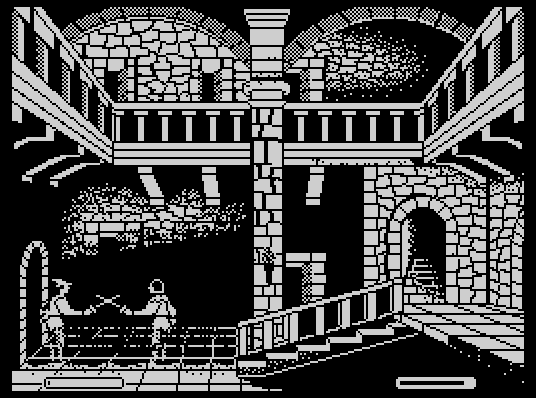
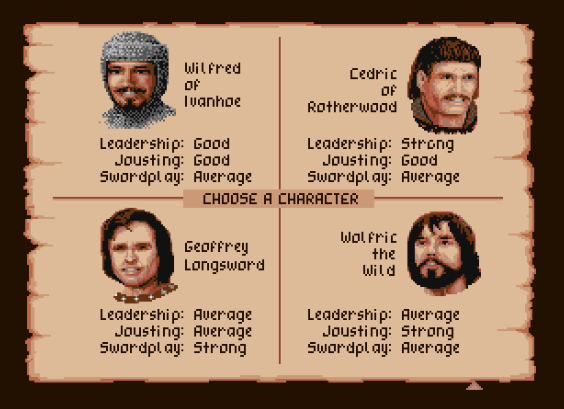
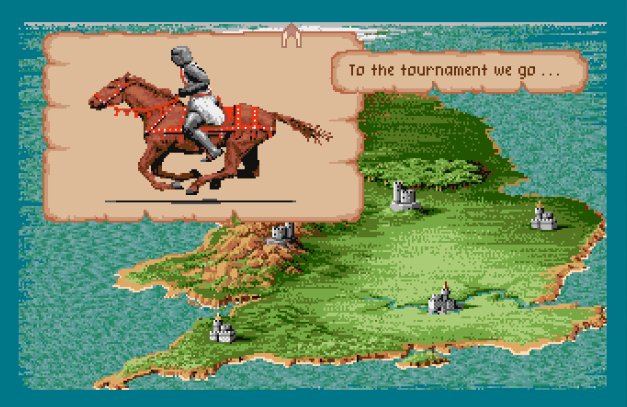
The game is set in England in 1149 during the Middle Ages where, following the death of the king, different factions are fighting for territorial control. The player assumes the role of a Saxon (Wilfred of Ivanhoe, Cedric of Rotherwood, Geoffrey Longsword or Wolfric the Wild) and tries to fight off the Norman hordes and wrestle for control of England. Eventually, the player must fight for control of all territories, and potentially those controlled by other Saxons, if they have become antagonistic. The player must amass armies and fight for control of opponents' castles. The player may engage enemy armies in battle, loot or lay siege to opposing castles. Territories can also be won in the periodic jousting contests. From time to time the player may attempt to rescue a damsel in distress and can appeal for help from the legendary bandit Robin Hood.
(ZX Spectrum 48K version)
The game's strategy boils down to a war of attrition as the player tries to amass larger armies than his opponents and manages to attack their territories at the right time.
Due to financial strains, Cinemaware decided to release the initial version without all the features originally planned for because of their need for revenue. Some features were partially implemented, but were removed so the game could be shipped. Some additional features completed but never seen in the shipped game include flaming fireballs (launched via the catapult), more locations (more varied castles to attack) and more in-depth strategy. Some of these features were implemented in the ports of the game.
(Amiga version)
Jim Sachs, the primary artist for the game, showcased some of these features on the Amiga during interviews after the release of the game.
Platforms:
DOS, NES, Apple IIGS, Atari ST, Apple Macintosh, ZX Spectrum, Amstrad CPC, Commodore 64, Commodore Amiga, Commodore CDTV, CD-i, Windows, Game Boy Advance, iOS
Leisure Suit Larry in the Land of the Lounge Lizards is a graphic adventure game originally released in 1987 as the first part of the Leisure Suit Larry series. Originally developed for the PC DOS and the Apple II, it was later ported to other platforms such as the Amiga, Atari ST, Apple IIGS, Apple Macintosh, and the Tandy Color Computer 3. It utilizes the Adventure Game Interpreter (AGI) engine made famous by King's Quest: Quest for the Crown.
The game's story follows a middle-aged male virgin named Larry Laffer as he desperately tries to "get lucky" in the fictional American city of Lost Wages. Land of the Lounge Lizards establishes several elements which recur in the later Larry games, including Larry's campy attire, perpetual bad luck with women, and penchant for double-entendres. The story and basic structure of the game are lifted from Softporn Adventure, a 1981 Apple II text adventure.
Larry Laffer is a 38-year-old (40-year-old in the 1991 remake) "loser" who lives in his mother's basement and has not yet lost his virginity. Having grown weary of his lonely existence, he decides to visit the resort city of Lost Wages (a parody of "Las Vegas") hoping to experience what he has not lived before, and to finally find the woman of his dreams. Larry starts with nothing but an out-of-style 1970s disco-era leisure suit and $94 in his pocket. His quest involves four possible women: a nameless, seedy-looking sex worker; Fawn, a club-goer of low moral fiber; Faith, a receptionist who (true to her name) is faithful to her boyfriend; and Eve, a bathing beauty and Larry's ultimate goal.
Banner Mania was a banner making program for IBM PC compatible computers, enabling the user to create banners, posters, signs and logos.
It was released by Brøderbund in 1989 and was developed for Pixellite Group by Presage Software Development and written by Christopher Schardt and Dane Bigham.
It allowed the user to create and print multi-page banners, with 19 different fonts and effects in 16 colors.
The PC version supported MDA, CGA, Hercules, TGA, EGA and VGA graphic modes. Basic requirements were a 8088 based computer with 580k of free conventional memory running MS-DOS 2.0 or PC DOS 2.1. A license cost $35 in 1991.
A Mac version was announced in 1990, selling for $59.95.
Today Banner Mania is considered as abandonware software and can be free download here.