Back to the Future is the name of a 1985 video game released by Electric Dreams Software for the ZX Spectrum, Commodore 64 and Amstrad CPC. The game is loosely based on the 1985 film of the same name.
CPC version
CPC version
C64 version
C64 version
The game is a side view arcade adventure. The aim of the game is to get George McFly to spend as much time as possible with Lorraine Baines. The more time George and Lorraine spend together, the more they will fall in love, and thus more segments will be added to the family photograph in the bottom right corner. The photographs in the bottom right and left of the screen gradually disappear if the players does nothing, thus setting a time limit on the game.
The player can find various object to help him such as love poems, a cup of coffee, alien suit and a guitar. He also has a skateboard to move around quickly.
Defender of the Crown is a strategy computer game designed by Kellyn Beck. It was Cinemaware's first game, and was originally released for the Commodore Amiga in 1986, setting a new standard for graphic quality in home computer games.
In 1987 it was ported to DOS, the Nintendo Entertainment System (NES), Atari ST, ZX Spectrum, Amstrad CPC, Commodore 64, Macintosh and finally, the Apple IIGS in 1988. It was later ported to the CD-i.
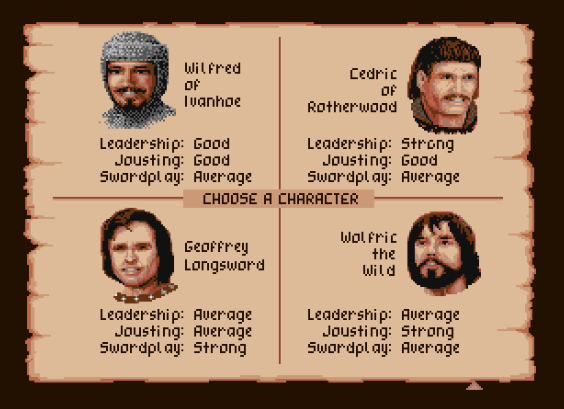
(DOS Version)
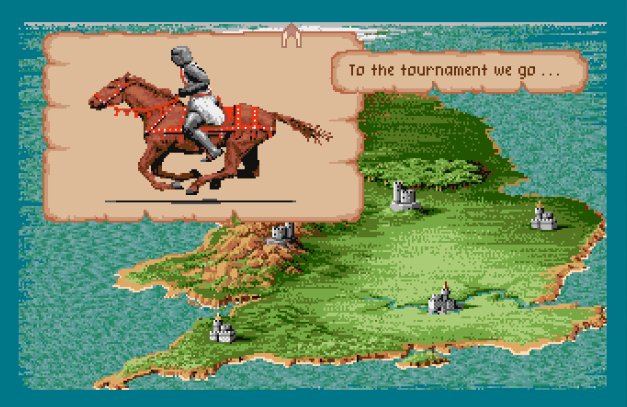
The game is set in England in 1149 during the Middle Ages where, following the death of the king, different factions are fighting for territorial control. The player assumes the role of a Saxon (Wilfred of Ivanhoe, Cedric of Rotherwood, Geoffrey Longsword or Wolfric the Wild) and tries to fight off the Norman hordes and wrestle for control of England. Eventually, the player must fight for control of all territories, and potentially those controlled by other Saxons, if they have become antagonistic. The player must amass armies and fight for control of opponents' castles. The player may engage enemy armies in battle, loot or lay siege to opposing castles. Territories can also be won in the periodic jousting contests. From time to time the player may attempt to rescue a damsel in distress and can appeal for help from the legendary bandit Robin Hood.
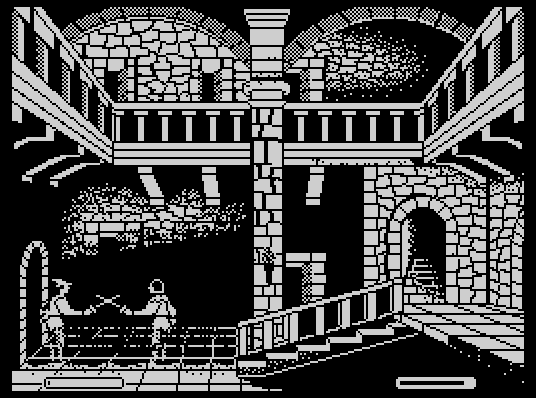
(ZX Spectrum 48K version)
The game's strategy boils down to a war of attrition as the player tries to amass larger armies than his opponents and manages to attack their territories at the right time.
Due to financial strains, Cinemaware decided to release the initial version without all the features originally planned for because of their need for revenue. Some features were partially implemented, but were removed so the game could be shipped. Some additional features completed but never seen in the shipped game include flaming fireballs (launched via the catapult), more locations (more varied castles to attack) and more in-depth strategy. Some of these features were implemented in the ports of the game.
(Amiga version)
Jim Sachs, the primary artist for the game, showcased some of these features on the Amiga during interviews after the release of the game.
Platforms:
DOS, NES, Apple IIGS, Atari ST, Apple Macintosh, ZX Spectrum, Amstrad CPC, Commodore 64, Commodore Amiga, Commodore CDTV, CD-i, Windows, Game Boy Advance, iOS