Showing posts with label ZX Spectrum. Show all posts

11/6/15

Sinclair ZX Spectrum 48K


INTRO


The Sinclair ZX Spectrum was one of the most popular European computers of the 80's. Two models were launched: one with 16 kb RAM and one with 48 kb RAM.


Specifications:
ORIGIN: United Kingdom
PRODUCTION: 1982 - 1984
BUILT IN LANGUAGE: Sinclair Basic
KEYBOARD: QWERTY rubber keyboard (40 keys) with up to 6 functions by keys !
CPU: Zilog Z80 A 3.5 MHz
RAM: 16k or 48k (42k left for programming)
ROM: 16k (Basic & OS)
TEXT MODES:   32 x 24
GRAPHIC MODES:   256 x 192
COLORS: 8 with two tones each (normal and bright)
SOUND: 1 voice / 10 octaves (Beeper)
I/O PORTS: Expansion port, tape-recorder (1200 bauds), RF video out
POWER SUPPLY:  External PSU, 9v DC, 1.4A (centre polarity = -ve)
PERIPHERALS: ZX printer, ZX microdrives


Power Supply Unit
Joystick controller

ZX Spectrum 48K and Jostick controller


One of its most "interesting" characteristics is its keyboard! Some keys have more than five (!) functions! It is impossible to type BASIC keywords letter by letter, instead you have to use function keys. A lot of peripherals and programs were developed for this computer.


ZX Spectrum BASIC


Sinclair BASIC was a popular version of the BASIC (Beginner's All purpose Symbolic Instruction Code) programming language. Originally Sinlair BASIC was written for the ZX80. On the ZX Spectrum, there are 86 reserved words in Sinclair BASIC, denoting commands (of which there were 50), functions (31), and other keywords (5).


The fact this was retained is a clue as to what Sir Clive originally intended his first colour computer to be, not the games machine as we all now remember it, but instead (and like the ZX81) a multi-use hobbyists machine which could also be used as a tool for programming.


You can find great manual for Sinclair BASIC at World of Spectrum site.


GAMING


If we hark back to April 1982, it's not hard to remember why the Spectrum had such a monumental impact on modern gaming. Prior to that we were living in a black and white world of Intellivision-style 'TV games' and endless, (hardly) glorified versions of Pong.


Most Spectrum software was originally distributed on audio cassette tapes. The Spectrum was intended to work with a normal domestic cassette recorder, and despite differences in audio reproduction fidelity, the software loading process was quite reliable, if somewhat slow (by today's standards).

Becouse of that, today we can load games from smartphone, using android apps like TeeZix
Enter LOAD "" command on ZX Spectrum, choose tape file in TeeZix and play it. And wait for some time to load game.


According to the 90th issue of the British gaming magazine GamesMaster, the ten biggest games released on the ZX Spectrum were (in descending order) Head Over Heels, Jet Set Willy, Skool Daze, Renegade, R-Type, Knight Lore, Dizzy, The Hobbit, Way Of The Exploding Fist, and Match Day 2 (source: Wikipedia).


Educational Software


Educational titles were not very popular for the ZX Spectrum, no matter how many times we told Mom and Dad that we needed the Speccy for our education, everyone really knew (including Mom and Dad I suspect) that we only wanted to play JetPac. Here's examples of Croatian educational software from that time.





10/21/15

Back to The Future Video Game (1985.)

Back to the Future (1985)

ZX Spectrum, Amstrad CPC, Commodore 64

Back to the Future is the name of a 1985 video game released by Electric Dreams Software for the ZX Spectrum, Commodore 64 and Amstrad CPC. The game is loosely based on the 1985 film of the same name.


CPC version
CPC version
C64 version
C64 version

The game is a side view arcade adventure. The aim of the game is to get George McFly to spend as much time as possible with Lorraine Baines. The more time George and Lorraine spend together, the more they will fall in love, and thus more segments will be added to the family photograph in the bottom right corner. The photographs in the bottom right and left of the screen gradually disappear if the players does nothing, thus setting a time limit on the game.

The player can find various object to help him such as love poems, a cup of coffee, alien suit and a guitar. He also has a skateboard to move around quickly.

ZX Spectrum 48K version


Back to The 1985.

Today is October 21, 2015 - the famous "Back to the Future Day". In "Back to the Future Part II," Marty McFly travels to October 21, 2015, to save his children, yet to be born in "Back to the Future's" 1985.


We will go to oposit time direction, to the 1985 to see 5 most popular games from that year!

1. Super Mario Bros. (NES)


Plumber brothers Mario and Luigi are transported to the Mushroom Kingdom, where they must stop the evil Koopa King, Bowser, and his reign of terror.


2. Bruce Lee (ZX Spectrum 48K)


Bruce Lee is a platform/beat 'em up hybrid, in which the player controls Bruce Lee. The plot involves the eponymous martial artist advancing from chamber to chamber in a wizard's tower, seeking to claim infinite wealth and the secret of immortality. There are twenty chambers, each represented by a single screen with platforms and ladders. To progress, the player must collect a number of lanterns suspended from various points in the chamber.


3. The Goonies (Commodore 64)


A good conversion of the movie The Goonies in a video game. Multicoloured 2D graphics, whereby each level covers one screen. 8 rather tricky levels need to be solved and can demand a lot from you.


The Goonies are a group of kids or youths. Everything starts with an unscrupulous property shark who wants to purchase the kids' housing complex and the parents lack the money that is needed to prevent the pending sequestration.
In the house of their leader Mikey the group makes an unusual discovery. They find a treasure map which is supposed to lead to the hideout of "One-eyed Willie", a pirate.
Mikey can convince his friends to go for a treasure hunt. This starts in an abandoned restaurant. The evil Fratellis have settled in there. So after all Goonies, except for Chunk who is supposed to call the police, have entered a system of catacombs through a manhole in the restaurant, the adventure really begins. So the kids do not only have to beware of mean traps and bats, but also of Mama Fratelli.
The game starts in the restaurant with the search for the manhole into the catacombs and contains 8 rather tricky levels full of riddles and adversities. The aim of the game is to bring safely both Goonies to the exit in Level 1-7 and in the eighth level to get to the treasure with both Goonies. Help the Goonies during their adventure...

4. Star Wars: The Empire Strikes Back (Amiga)


Star Wars: The Empire Strikes Back is the sequel to the vector graphics Star Wars arcade game. It was released by Atari Games in 1985 as a conversion kit for the original game. As in Star Wars, the player takes the role of Luke Skywalker in a set of familiar battle sequences in a first-person perspective. Specifically, the arcade features the Battle of Hoth and the subsequent escape of the Millennium Falcon through an asteroid field. The game was also released for various home computers in the late 80's by Software company Domark Ltd. Ports of the game included the Amstrad CPC, ZX Spectrum, Atari St & Commodore 64 and Amiga.


5. Where in the World Is Carmen Sandiego? (IBM PC - DOS)


The goal of the game is to track Carmen's villains around the world, arrest them and ultimately arrest Carmen herself. The player begins the game by first going to the country where the crime took place and then obtaining hints from various sources on where the thief went next, leading to a chase around the world to find the thief before time runs out.


Each case begins with the user being alerted that a spectacular theft has been committed. Starting by first traveling to the scene of the crime, the player is given several opportunities to collect clues about the suspect's next location, which come in the form of pun-filled word play about the target place. There are thirty countries that can be visited in the game and each is identified by the name of a prominent city, though this city is not always consistent with the image of the country shown in the game. For example, Lima is given for Peru, but the game instead shows an image of Machu Picchu.

If the player travels to an incorrect location, they receive nonsensical clues and will have to backtrack to the previous location to try again. If the player travels to the correct location, a simple animation of an obvious but otherwise harmless V.I.L.E. henchman lurking across the screen is played. The gameplay continues to repeat in this manner as the player travels from location to location several times before catching up to the criminal.


10/16/15

Defender of the Crown (1986.)

Defender of the Crown is a strategy computer game designed by Kellyn Beck. It was Cinemaware's first game, and was originally released for the Commodore Amiga in 1986, setting a new standard for graphic quality in home computer games.


In 1987 it was ported to DOS, the Nintendo Entertainment System (NES), Atari ST, ZX Spectrum, Amstrad CPC, Commodore 64, Macintosh and finally, the Apple IIGS in 1988. It was later ported to the CD-i.

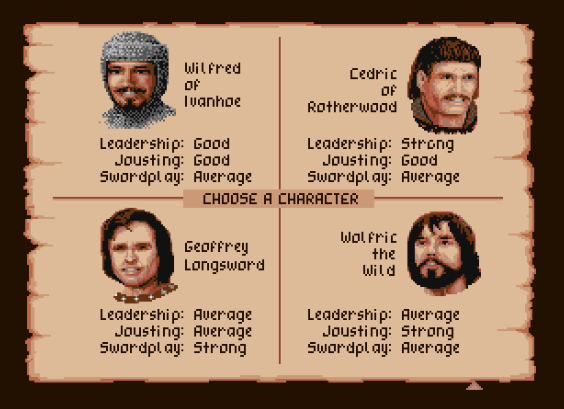
(DOS Version)

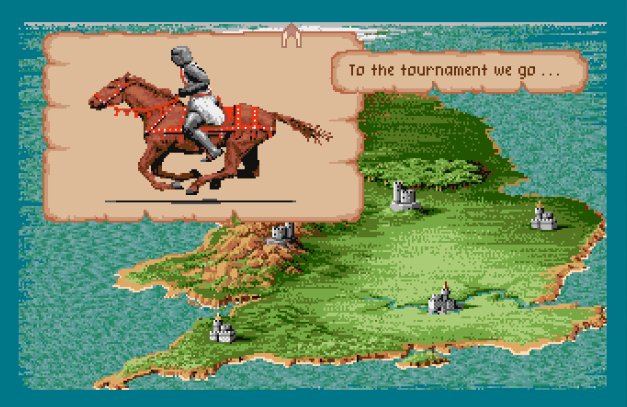
The game is set in England in 1149 during the Middle Ages where, following the death of the king, different factions are fighting for territorial control. The player assumes the role of a Saxon (Wilfred of Ivanhoe, Cedric of Rotherwood, Geoffrey Longsword or Wolfric the Wild) and tries to fight off the Norman hordes and wrestle for control of England. Eventually, the player must fight for control of all territories, and potentially those controlled by other Saxons, if they have become antagonistic. The player must amass armies and fight for control of opponents' castles. The player may engage enemy armies in battle, loot or lay siege to opposing castles. Territories can also be won in the periodic jousting contests. From time to time the player may attempt to rescue a damsel in distress and can appeal for help from the legendary bandit Robin Hood.


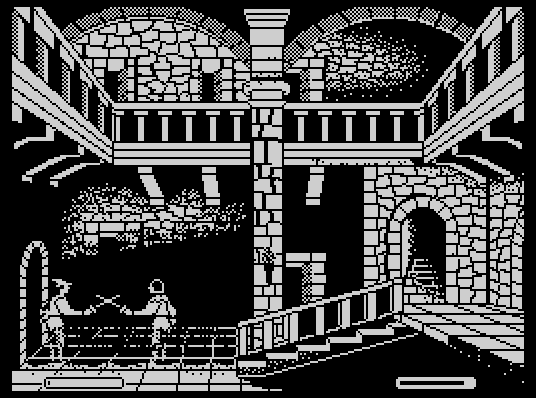
 (ZX Spectrum 48K version)

The game's strategy boils down to a war of attrition as the player tries to amass larger armies than his opponents and manages to attack their territories at the right time.

Due to financial strains, Cinemaware decided to release the initial version without all the features originally planned for because of their need for revenue. Some features were partially implemented, but were removed so the game could be shipped. Some additional features completed but never seen in the shipped game include flaming fireballs (launched via the catapult), more locations (more varied castles to attack) and more in-depth strategy. Some of these features were implemented in the ports of the game.


(Amiga version)


Jim Sachs, the primary artist for the game, showcased some of these features on the Amiga during interviews after the release of the game.


Platforms:
DOS, NES, Apple IIGS, Atari ST, Apple Macintosh, ZX Spectrum, Amstrad CPC, Commodore 64, Commodore Amiga, Commodore CDTV, CD-i, Windows, Game Boy Advance, iOS


10/15/15

Single line programming

Can we make interesting graphics with only single program line? Yes, we can!

ZX Spectrum 48K - BASIC:
10 PRINT CHR$(132.2+RND*1);:GO TO 10


Iskra Delta Partner - MBasic:
10 PRINT CHR$(94.2+RND(1));:GOTO 10


Commodore 64 - BASIC:
10 PRINT( CHR$(205.2+RND(1));: GOTO 10


PC 486 - QBASIC:
10 PRINT CHR$(205.2+RND(1));:GOTO 10